Progressive Die Stamping
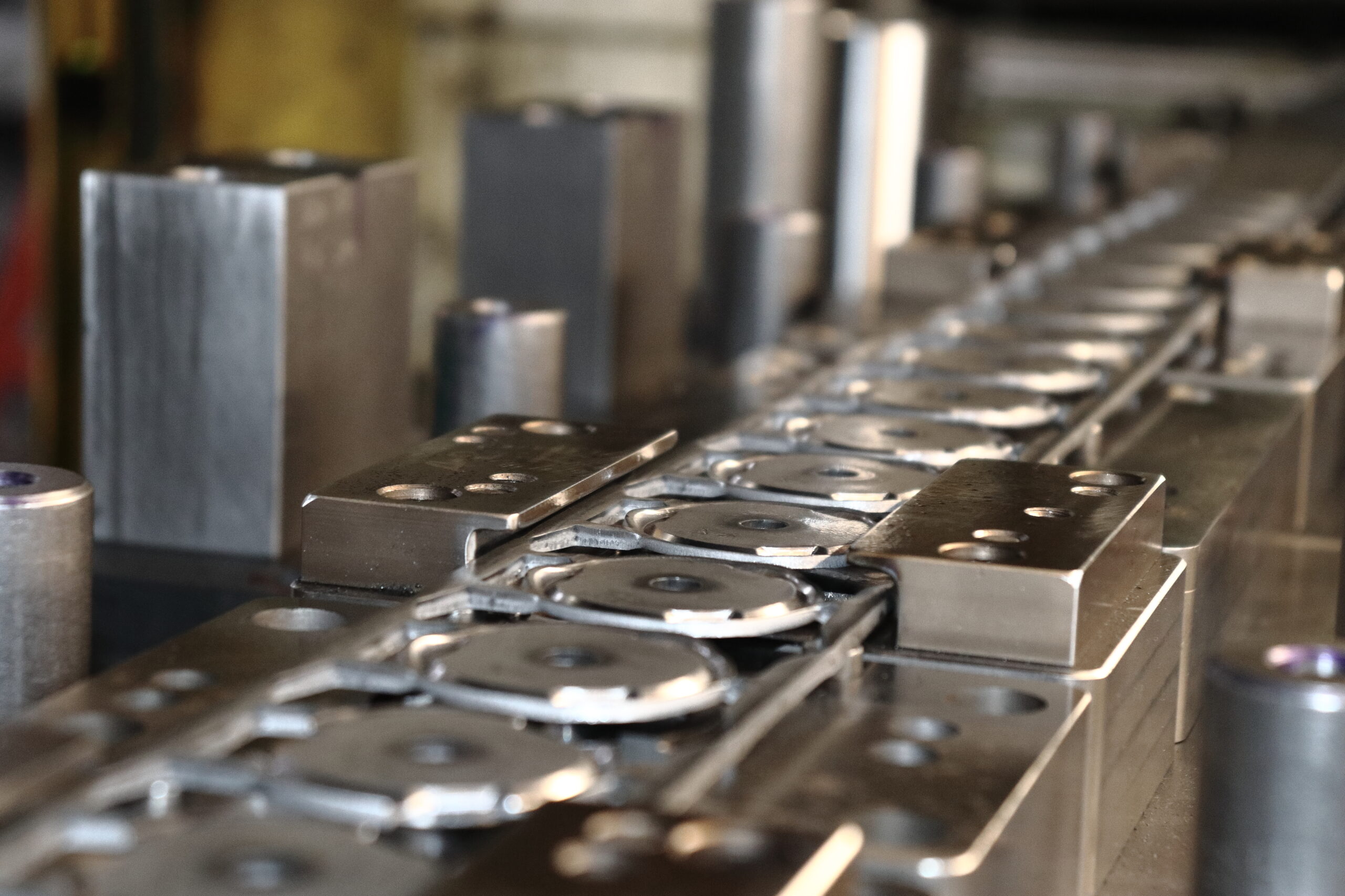
In progressive die stamping, an automatic feeding system pushes a strip of metal through multiple stations within a stamping die. As the strip advances through the tool, the part remains connected to the surrounding metal strip and moves sequentially from one station to the next. At each stage, the die performs specific operations, such as bending, forming, and piercing, gradually shaping the component into its final geometry.
As the strip continues through the die, each station builds on the previous stamping until the part reaches its finished form. Finally, one of the last stations trims the completed part from the metal strip, separating it from the carrier metal strip.
Compared with transfer press stamping, the progressive die stamping process typically requires more raw material. However, progressive dies offer significant production advantages. For example, prog-dies allow faster setup times and enable manufacturers to produce two or more parts simultaneously within the same die, increasing overall production efficiency.
Despite its versatility and high-speeds, progressive die stamping is not always the optimal solution for parts that require extensive deep-drawing to achieve their final shape. In those cases, transfer press stamping often provides better forming capability and material control. At JMS Incorporated, we integrate both transfer and progressive die stamping daily, depending on the scheduled production.
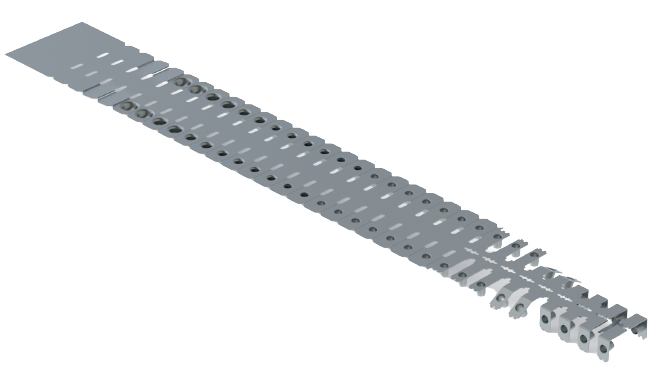
The image illustrates how a part is “carried” within the strip of steel as the progressive die gradually forms the component at each station along the tool.
PRODUCTION STARTS HERE
Have a new project in mind? Contact our team to find out how JMS Incorporated can add value to your unique design.